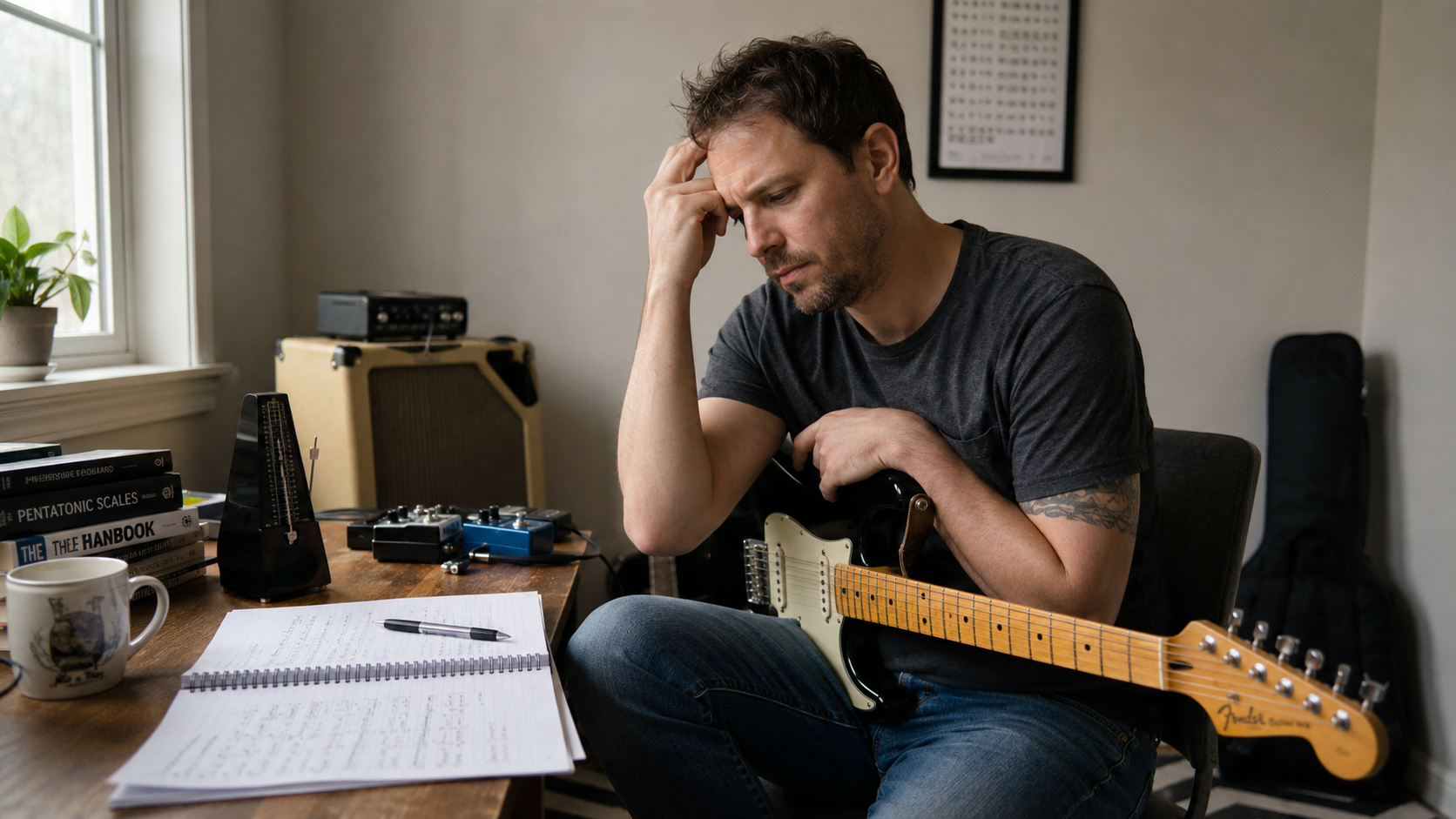
There’s a special kind of frustration that only sets in after you’ve been playing for years. It's a malaise that affects us all at one time or another.
On the one hand...
You’ve got chord shapes down, a good few songs under your belt, some pentatonic shapes memorised, a bucket of licks under your fingers, and maybe even a bit of theory.
And yet.
You still don’t feel like the guitarist you thought you’d be by now.
When there’s no tab to follow, no familiar backing track to hide inside, and no YouTuber pointing at the fretboard telling you where to put your fingers, you feel vulnerable, exposed and unsure.
“After all these years, why do I still feel like an intermediate guitarist?”
You’re just there holding your guitar, expected to make actual musical decisions.
That’s when ask yourself:
“After all these years, why do I still feel like an intermediate guitarist?”
Here’s my 2 cents…
Your solution isn't learning more information, it's connecting the information you already know so it's useful and usable.
You might be better than you think, but less connected than you hoped
You can be genuinely decent at guitar and still feel weirdly incomplete and a bit adrift. You have reasonable technique, you know musical stuff (and continue to learn), and you practice regularly. But certain things make your stomach drop, and leave your swirling in self-doubt. Things like:
Building a solo
Working something out by ear
Responding to "Move to the vi chord for the middle 8" call at a jam.
The intermediate guitarist's trap
You sit down to practise and realise you’ve got 42 possible things you could work on, but no idea what you should work on. And in what order?
That’s the trap. You've got skills but they don’t work for you as a connected system. They’re more like a drawer full of random cables – you know there’s useful stuff in there, but when you actually need something, you’re untangling shit for 20 minutes.
Your frustration isn’t because you’re a bad guitar player, it's because your skills are uneven and unconnected.
You might have strong hands but weak ears. Good chord memory but poor rhythm. Lots of licks but no phrasing. Decent theory knowledge but no practical way to use it.
That’s why I reckon learning more isn’t the answer. Most of my students experience breakthroughs by joining up what they already know (with my help, of course).
The symptoms of being stuck as an intermediate guitarist
This stuck feeling isn't something specific, it’s more like a constant low-level sense that something important hasn’t clicked yet.
You can play some impressive things, but don’t feel like you can really play. You know scales, but your solos still sound like exercises. You learn a new lick, but use it in the same old place, with the same old rhythm.
Other symptoms include:
You can follow lessons, but struggle to make your own musical decisions.
You sound fine at home, then fall apart with other musicians.
You have loads of saved videos, tabs and exercises, but no clear path.
You keep practising, but don’t feel like the practice is giving you the fretboard freedom you seek.
You can noodle for ages, but struggle to create something deliberate.
You know bits of songs, but not enough full songs to feel properly useful.
This is why “just practice more” is such useless advice.
You probably already have practised more, but those hours have been reinforcing the same gaps, the same habits, and the same little comfort zones.
You’re stuck because you’re chasing “the more”
Most intermediate players that come to me seem to think their next breakthrough is hiding behind the next thing:
More scales (fuck no!)
More licks
More theory (fuck noo!)
More chord shapes
More modes. (fuck, nooo!)
More saved Instagram exercises from a guitarist who fingers are longer than a steel rule.
I get it. Chasing the “more” gives you something to do. It feels productive.
But if your playing already feels scattered, adding more scattered information won’t help. It just adds to the drawer full of random cables.
The real question is:
Can you use what you already know when the music starts?
Can you stay in time? Hear something and find it on the fretboard? Take one idea and develop it? Play through an entire song start to finish, without getting lost?
Yes, its less sexy than “learn five exotic scales this weekend”.
More useful, though.
The 7 sins of practice that keep you intermediate
Some practice makes you better, some practice just makes your existing habits more permanent.
You get good at what you practice.
“If your practice doesn’t challenge your weak links, you’re mostly rehearsing the plateau”
If you spend years noodling in the same box shape, you get really good at noodling in that box shape. If you always avoid the metronome, you get really good at avoiding the metronome. If you only play things you already know, you get better at hiding from the things you don’t.
Classic intermediate practice traps include:
Noodling over backing tracks with no specific goal.
Running scales without turning them into phrases.
Learning licks without knowing where they fit and the chords underneath them
Watching multiple lessons instead of applying one idea properly.
Playing familiar material because it feels safe.
Avoiding timing and ear training work because they expose you, and you don't like how that feels
Collecting fragments of songs instead of learning complete songs.
The dangerous bit is that all of this can feel like practice cos you’ve got the guitar in your hands. You’re making noise. Surely that counts?
But nah, if your practice doesn’t challenge your weak links, you're mostly rehearsing the plateau.
You’re not digging yourself out of this hole, you're just decorating it.
Five gaps that keep you feeling intermediate
Most long-term stuck players I’ve met have one or more of these gaps. Usually more than one.
1. Time feel
Bad timing makes everything sound less good.
Doesn’t matter if the chord is fancy or the lick came from Steve Vai himself. If your timing is loose, rushed, dragging, the whole thing sounds a bit shit. It's hard to put your finger on it when listening back, but it just doesn't vibe.
That's because time feel affects rhythm parts, riffs, chord changes, fills, solos and playing with other people.
Basically, everything.
If I had a dollar for every time a student said: "There's something wrong with your metronome.", I'd be fucking Jeff Bezos.
I work on this often. You should too.
2. Ear training
If you can’t hear simple harmonic movement, you stay dependent on tabs, shapes and visual memory.
Ear training doesn’t mean identifying every jazz chord by ear, it just means:
Recognising intervals and knowing where to find them in relation to your root note
hearing a simple phrase, holding it in your minds ear and replicating it on the fretboard.
Hearing the quality of chords: major, minor, augmented, diminished, maj7, dom7, min7, min7b5.
Recognising common movements in music like ii-V-I or I-IV-V
Working out melodies/licks by ear and transcribing them. Or making chord charts for songs
Given that YouTube/Patreon provides all the tabs you could ever need. Why would you need to work things out for yourself?
Because without listening, and connecting your ears to your fingers, you won't ever be the player you want to be.
So far you've been given the fish but you haven't taught yourself how to fish.
3. Fretboard connection
Fretboard connection means seeing how the things you already know relate to each other: chord shapes, triads, scales, intervals, arpeggios.
Same musical information. Different layers.
My student Tim (playing 20+ years) said "I thought these were all different things and I was overwhelmed by trying to remember them all. "
"When you showed me that they were all aspects of the same thing, I finally got it – it was bloody brilliant! "
4. Phrasing
Your soloing falls apart here cos scales aren’t enough to teach you what you need to know. Even correct notes played with no rhythm, space, repetition, or intention still sound meandering and mediocre
Phrasing is how you turn notes into meaningful melodic passages.
It’s the difference between talking in sentences and reciting the alphabet.
5. Repertoire
Okay, okay. I admit it. For years I did this shit.
I cherry-picked my favourite licks and riffs, thinking I was cool, and enjoying myself in a self-indulgent way.
But after the Amanda Incident, I was humbled.
I realised that I couldn't play one song all the way through. And that's all people wanted to hear.
Songs!! Songs are your currency as a musician.
If you mostly collect riffs, licks and exercises, you're neglecting the insights that come from learning full songs.
Songs teach structure, transitions, memory, rhythm, and what the guitar is actually doing while the singer handles the important bit. Many guitar players consider these passages boring as the guitar isn’t doing much but that’s the whole point. Guitar parts get simpler and more sparse under the vocals to provide space for the singer to deliver the main narrative. Also so they contrast with the busier, more energetic sections like the chorus.
Exercises can hide gaps while songs expose them.
That’s why they’re useful.
If this is happening, start here
If you read the last section and thought, “Great, so I’m broken in five different places,” that’s not exactly motivating. The hard part is knowing where to begin.
So don’t fix everything at once, or even try to.
Diagnose the loudest problem first.
| If you struggle with... | Fix this first |
|---|---|
| Solos sounding samey | Phrasing and chord tones |
| Falling apart with a metronome or band |
Time feel |
| Always needing tab | Ear training |
| Getting lost on the neck | Fretboard connections |
| Knowing riffs but not sounding musical |
Full songs and rhythm |
| Freezing when asked to improvise | Phrase creation |
| Playing lots but not improving | Practice structure |
| Sounding mechanical | Rhythm, space and dynamics |
Pick the thing that makes you wince.
Your ego will try to steer you toward the easier one. Tell it to shut up.
What to fix first
In a perfect world, I’d say start with time feel. Bad timing makes everything sound amateur, and better timing makes almost everything sound more confident.
After that, ear training matters because it connects your fingers to actual sound. Chord-tone awareness helps you make better choices over changes. Phrase development turns those choices into music. Full songs keep the whole thing honest.
So your priority order could look like this:
Time feel
Ear training
Chord-tone awareness
Phrase development
Full songs
But your first fix should be the weakest link that affects the most other things.
If your time-keeping is terrible, start there. If you can’t hear anything before you play it, start with ear. If your solos sound like pentatonic soup, work on phrasing and chord tones.
Pick one. Make it small. Show up consistently. Do it properly.
Incremental improvement is rarely noticed by you
Progress at this stage usually isn’t dramatic.
Sorry.
It’s smaller than one magical practice session followed by you playing like Robben Ford, and that makes it harder to recognise progress.
That’s why you should record everything. Because when you feel demotivated as you haven’t improved, listen to last month’s recordings to realise you actually have but the shift was too subtle.
Winning is also a deeper awareness, a noticing of yourself like noticing when you rush. Or singing a phrase and finding it without tab, or landing on a chord tone deliberately instead of arriving there by accident
It can also look like:
You repeat an idea without panicking.
You leave space without feeling like you’ve failed.
You hear when something doesn’t fit.
You practise one thing without ditching to watch 12 unrelated videos.
You play fewer notes and sound more musical.
You recover when something goes wrong instead of collapsing completely.
That’s progress. It’s not always exciting. But it’s the stuff that changes how you actually sound.
You’re not intermediate forever
You’re not doomed. You’re not too old. You’re not lacking the magic natural talent gene that real guitarists apparently received in the post.
You probably have years of uneven skill development, random practice habits and disconnected information.
Annoying? Yes. Fixable? Also yes.
Start with your weak link, document your start point. Be single-minded and don’t get distracted. Do this one thing. Make it something you can actually do tomorrow, and keep doing.
Good Luck